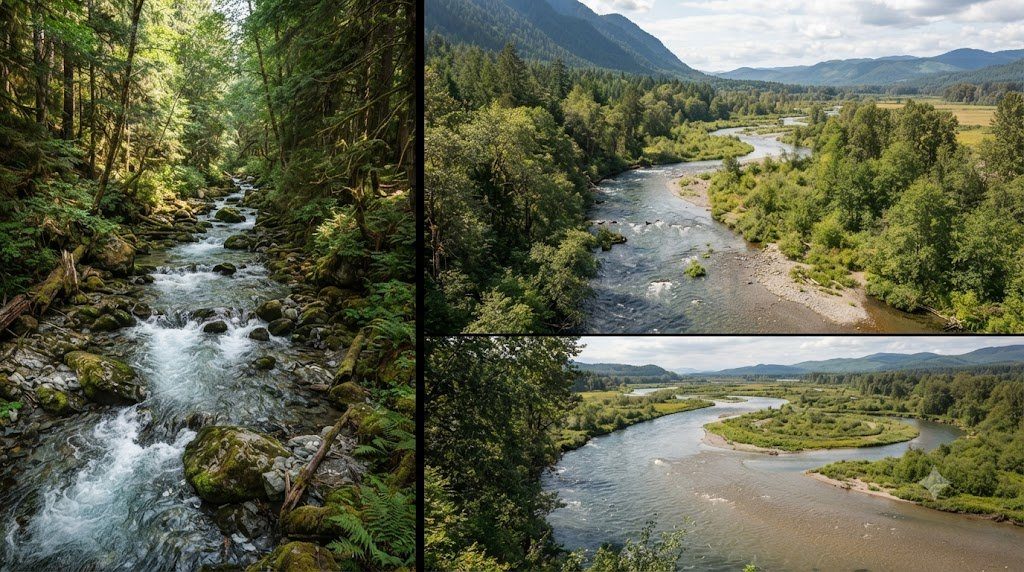
Welcome to FreshwaterLab Online (https://freshwaterlab.online/), an authoritative, peer-reviewed educational compendium and open-access research repository dedicated to the chemical, physical, ecological, and hydrogeological sciences of continental aquatic systems. From headwater fluvial torrents and continental river basins to deep lacustrine stratification, palustrine peat bogs, sub-surface karst aquifers, and complex benthic macroinvertebrate food webs, FreshwaterLab provides rigorous, field-verified reference manuals designed for limnologists, hydrologists, aquatic biologists, water resource engineers, university researchers, and environmental stewards worldwide.
Freshwater accounts for less than three percent of all water on Earth, and of that fraction, more than two-thirds is locked in polar ice sheets and alpine glaciers. The accessible liquid freshwater that sustains terrestrial life, human civilization, and irreplaceable riparian biodiversity—less than one percent of global water reserves—faces unprecedented anthropogenic pressures, including agricultural nutrient loading, groundwater over-extraction, thermal alteration, microplastic contamination, and dam-induced hydromorphological fragmentation. FreshwaterLab was established to bridge the divide between complex peer-reviewed academic literature and actionable, field-tested limnological science, empowering water professionals and passionate conservationists with the foundational knowledge required to understand, protect, and restore continental freshwater systems.
Our Guiding Mission, Ethos, and Editorial Philosophy
At FreshwaterLab, our editorial mission is guided by three non-negotiable principles: empirical scientific rigor, holistic watershed perspective, and transparent ecological methodology. We believe that effective freshwater stewardship cannot occur in fragmented silos. An agricultural plot in an upland catchment directly influences stream dissolved oxygen down-gradient; a municipal groundwater well drawdown alters hyporheic interstitial flow miles away; and wetland drainage eliminates the critical denitrification buffers that prevent downstream estuarine hypoxia.
Every comprehensive guide, technical monograph, and laboratory protocol published on FreshwaterLab is written from an evidence-based perspective. We prioritize empirical field telemetry, mass-balance stoichiometric calculations, peer-reviewed scientific citations (including the Journal of Hydrology, Limnology and Oceanography, and Freshwater Biology), and standard methods established by the United States Geological Survey (USGS) and international water science bodies. We avoid superficial generalities, offering our readers deep mechanistic explanations of hydraulic shear stress, trophic cascade dynamics, and biochemical redox cascades.
Dr. Julian Hayes: Senior Limnologist & Lead Scientific Editor
FreshwaterLab is founded and edited by Dr. Julian Hayes, a Senior Limnologist, Fluvial Hydrologist, and Aquatic Ecologist with over eighteen years of active field investigation across temperate, alpine, and subtropical catchment basins. Dr. Hayes earned his Master of Science in Fluvial Geomorphology and completed his Ph.D. in Limnology, specializing in lacustrine thermal stratification, epilimnetic-hypolimnetic phosphorus cycling, and hyporheic zone biofiltration mechanics.
Throughout his career, Dr. Hayes has directed comprehensive watershed diagnostics across major river systems, led continuous multiparameter sonde sensor deployments, calibrated two-dimensional hydrodynamic models, and conducted macroinvertebrate bioassessments evaluating watershed recovery following dam removal. His passion for demystifying aquatic chemistry and mentoring the next generation of freshwater scientists inspired the creation of FreshwaterLab Online as a free, globally accessible technical resource.
Five Foundational Scientific Pillars of FreshwaterLab
Our educational curriculum and ongoing investigative research span five interconnected domains of inland water science:
- Rivers & Fluvial Geomorphology: Thorough examinations of the River Continuum Concept (RCC), open-channel hydraulics, Manning’s roughness coefficient, Rosgen stream classification, sediment bedload transport, hyporheic water exchange, and longitudinal ecological connectivity.
- Lakes & Physical Limnology: Comprehensive guides to lacustrine thermal density stratification, thermocline kinetics, epilimnion/hypolimnion chemistry, dimictic turnover dynamics, internal phosphorus loading, and paleolimnological sediment coring.
- Wetlands & Palustrine Ecology: In-depth analyses of hydric soil biogeochemistry, anaerobic redox sequences, methanogenesis, denitrification kinematics, sphagnum peatland carbon sequestration, and Ramsar wetland conservation frameworks.
- Groundwater & Hydrogeology: Mathematical and geological treatments of Darcy’s Law, hydraulic conductivity, storativity, unconfined water tables, artesian pressure systems, karst dissolution voids, and seawater intrusion mitigation.
- Freshwater Ecosystems & Bioindicators: Biological surveys of Ephemeroptera-Plecoptera-Trichoptera (EPT) index bioassessments, microbial loop dynamics, trophic diatom indices, submerged aquatic vegetation (SAV) dynamics, and invasive species impacts.
Rigorous Research Standards, Field Calibration, and Peer Review
To guarantee that our content meets the highest standards of scientific fidelity, each article undergoes a strict four-phase verification workflow. First, all mathematical formulas and chemical reaction equations are cross-referenced against authoritative texts (such as Wetzel’s Limnology and Freeze and Cherry’s Groundwater). Second, field measurement methods are aligned with USGS National Field Manual protocols and EPA water quality assessment guidelines. Third, custom interactive tables and graphic callouts are constructed to provide immediate utility for fieldwork and academic study. Finally, all guides are audited for pedagogical clarity and complete accessibility.
Global Freshwater Stewardship and Open-Access Collaborative Science
Freshwater challenges transcend geopolitical borders. Whether managing transboundary aquifer depletion, mitigating toxic cyanobacterial harmful algal blooms (HABs), or restoring degraded riparian buffers, the global community of limnologists and water technicians requires reliable, transparent open data. FreshwaterLab is proud to participate in international open-science initiatives, providing educational resources to universities, community watershed associations, citizen-science monitoring networks, and environmental educators worldwide.
We welcome scholarly correspondence, field dataset contributions, and peer inquiries from our readership. Connect with Dr. Julian Hayes and our scientific staff directly through our Contact Us page or email us at editorial@freshwaterlab.online.
Catchment Observatories and Continuous Hydrological Monitoring
In support of our mission to deliver real-world empirical insights, FreshwaterLab collaborates with regional environmental monitoring stations and university research watersheds. Through continuous multiparameter telemetry logging—monitoring water temperature, pH, oxidation-reduction potential (ORP), specific conductance, and optical dissolved oxygen (ODO) at sub-hourly intervals—we provide readers with authentic case studies reflecting the dynamic, non-linear realities of natural aquatic ecosystems.
By fusing fundamental hydrological theory with modern telemetry and practical field protocols, FreshwaterLab Online equips scientists, students, and aquatic conservationists with the clarity and rigor required to navigate the pressing environmental challenges of the modern era. We invite you to explore our research archives, utilize our computational models, and join our global mission of science-driven freshwater conservation.
Interdisciplinary Watershed Restoration Frameworks
Effective freshwater management requires integrating fluvial geomorphology, hydrochemistry, and landscape ecology into unified restoration frameworks. FreshwaterLab advocates for process-based river and wetland naturalization—prioritizing the re-establishment of natural hydrologic regimes, sediment continuity, and channel-floodplain connectivity over artificial hard-armoring. Through detailed case studies analyzing dam removal outcomes, agricultural riparian re-vegetation, and wetland re-meandering projects, our monographs demonstrate how restored physical processes naturally foster resilient biological communities and long-term ecosystem stability.