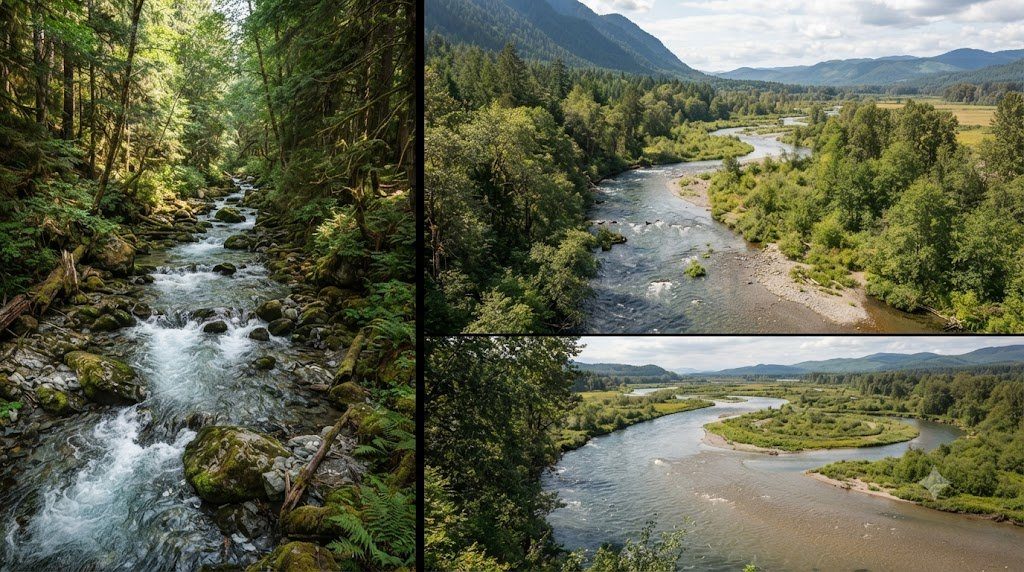
The Hyporheic Zone: Subsurface Fluvial Mixing, Biofiltration, and Interstitial Ecology
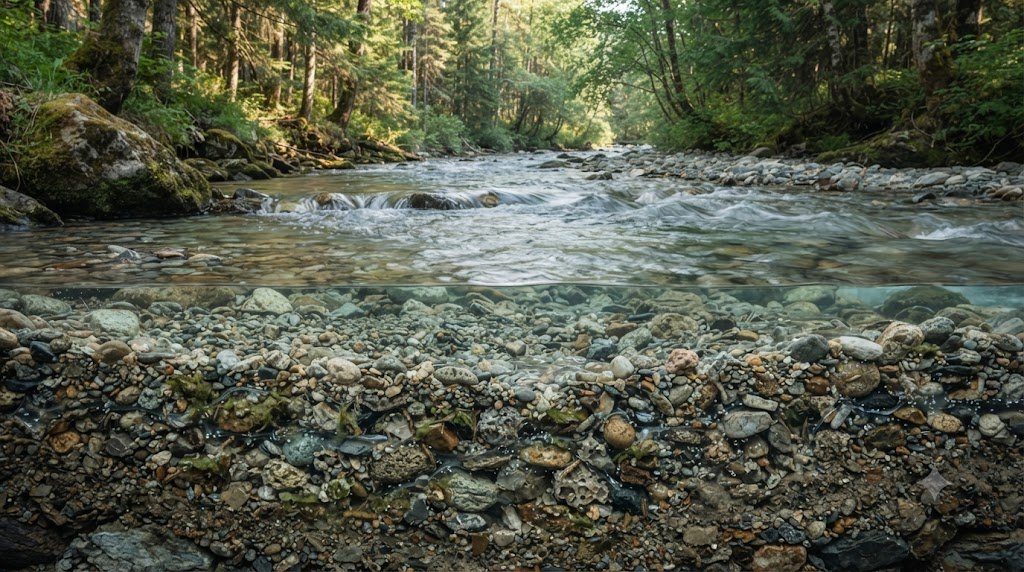
If you look at a gravel-bed river on a summer afternoon, you might assume that the entire ecosystem is contained within the surface water visible between the banks. In reality, a river is a three-dimensional entity: beneath the cobble bed and extending dozens of meters laterally beneath the riparian gravel terraces lies the Hyporheic Zone … Read more


Rosgen Stream Classification and Natural Channel Design: Valley Morphology and Bank Stability

When rivers are subjected to human channelization—straightened, dredged, and armored with concrete rip-rap to expedite agricultural drainage or urban development—they almost universally destabilize. Stripped of their natural sinuosity, channelized rivers experience steepened gradients, escalated boundary shear stresses, and severe bed degradation (incised ‘gullying’), which drops groundwater tables and triggers massive bank collapses. In response to … Read more

Open-Channel Fluvial Hydraulics: Manning’s Equation, Shear Stress, and Sediment Transport Mechanics

Every physical feature of a natural river—from the deep, languid pools where trout seek thermal refuge to the turbulent, oxygenating white-water riffles where caddisflies anchor their nets—is an equilibrium expression of open-channel hydraulics. Unlike closed conduits where liquid moves under pressurized mechanical boundaries, open-channel flow occurs with a free liquid surface exposed directly to atmospheric … Read more

The River Continuum Concept: Longitudinal Gradients, Energy Dynamics, and Biotic Zonation

Rivers are not merely passive conduits channeling precipitation downhill to the world’s oceans; they are dynamic, continuous physical and biological gradients that evolve systematically from headwater springs to continental estuaries. In 1980, a landmark synthesis published by Dr. Robin L. Vannote and his colleagues revolutionized aquatic science: the River Continuum Concept (RCC). Prior to the … Read more