Rivers are not merely passive conduits channeling precipitation downhill to the world’s oceans; they are dynamic, continuous physical and biological gradients that evolve systematically from headwater springs to continental estuaries. In 1980, a landmark synthesis published by Dr. Robin L. Vannote and his colleagues revolutionized aquatic science: the River Continuum Concept (RCC). Prior to the RCC, stream ecologists treated headwater brooks, mid-order rivers, and lowland channels as isolated, fragmented habitats. The RCC demonstrated that lotic (running water) ecosystems function as unbroken physical templates, where upstream ecological processing directly dictates downstream energy budgets, organic matter transport, and macroinvertebrate functional feeding groups.
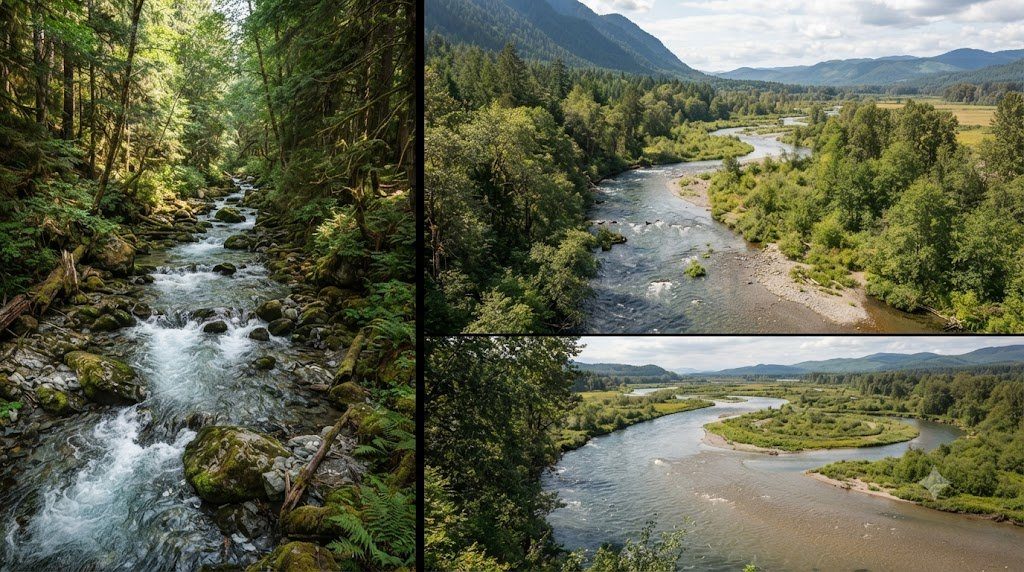
From cold, shaded, nutrient-poor 1st-order montane trickles dominated by coarse terrestrial detritus and shredding aquatic insects, to sunlit 4th-order braided gravel streams where primary production flourishes on rock periphyton, and finally down to deep, turbid, high-order lowland floodplains relying on fine organic suspensions, the RCC provides the unifying framework of modern fluvial limnology. In this comprehensive scientific monograph, we deconstruct the geomorphic, thermodynamic, and bioenergetic mechanics of the river continuum.
Strahler Stream Ordering and Longitudinal Geomorphic Evolution
To analyze fluvial ecosystems rigorously, hydrologists classify channels using the Strahler Stream Order classification. In Arthur Strahler’s topological hierarchy, a perennial stream segment with no tributaries is designated as a 1st-Order Stream. When two 1st-order channels unite, they form a 2nd-Order Stream; two 2nd-order streams merge to create a 3rd-Order Stream, and so on. Importantly, when a lower-order stream intersects a higher-order stream (e.g., a 1st-order joining a 3rd-order), the stream order remains unchanged. Globally, 1st through 3rd-order headwater streams constitute over 85% of total river network length, draining the vast majority of terrestrial catchments.
As water journeys downstream from 1st-order headwaters to 10th-order continental mainstems (such as the Mississippi, Amazon, or Danube), physical channel morphology undergoes profound systematic shifts:
- Channel Cross-Section & Width: Headwaters exhibit narrow, V-shaped bedrock or boulder-lined channels, whereas high-order systems form expansive, gently sloping alluvial valleys spanning hundreds of meters or kilometers in width.
- Thermal Regime & Insolation: Headwaters are heavily buffered by groundwater inputs and dense riparian forest canopies, limiting solar radiation penetration and moderating diurnal temperature swings. Mid-order reaches open up to full sunlight, driving peak thermal amplitude, while deep turbid lowland rivers experience high thermal inertia.
- Substrate Particle Size Sorting: Channel bed sediments grade from immovable boulders, cobbles, and coarse gravels in high-gradient mountain reaches down to fine sands, silts, and clays in low-gradient depositional floodplains.
The P/R Ratio: Primary Production vs. Community Respiration
The foundational metabolic metric of the River Continuum Concept is the ratio of gross primary productivity to community respiration (P/R Ratio). This dimensionless thermodynamic quotient dictates whether a lotic reach is an autotrophic solar-driven engine or a heterotrophic detrital-processing system:
- Heterotrophic Headwaters ($P/R < 1$): In heavily forested 1st-to-3rd-order headwater streams, dense riparian canopies block over 90% of photosynthetically active radiation (PAR). Consequently, gross photosynthesis ($P$) is minimal, while community respiration ($R$) fueled by the decomposition of terrestrial leaf litter is enormous. Energy input is overwhelmingly allochthonous (derived from outside the stream channel).
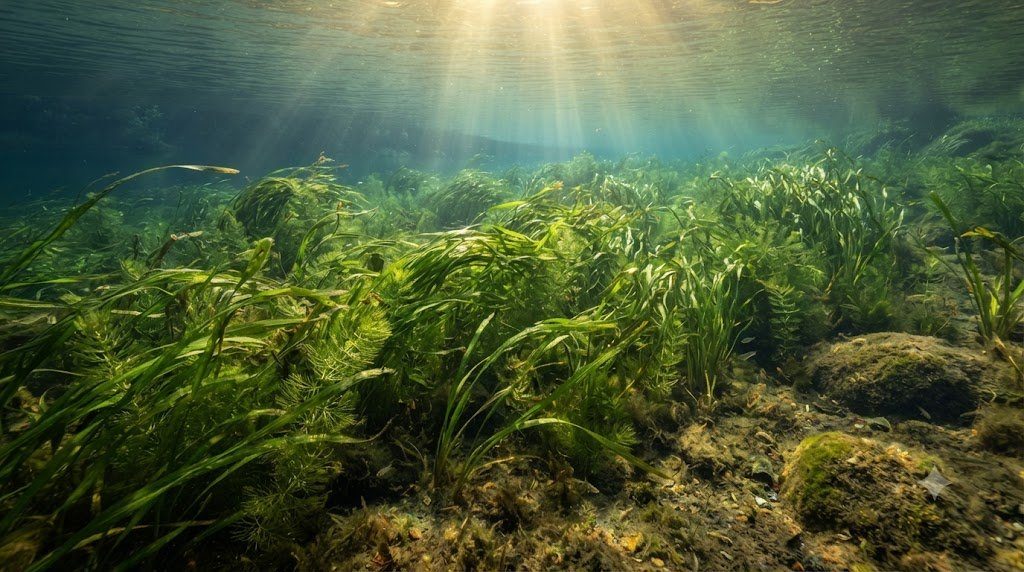
- Autotrophic Mid-Order Reaches ($P/R > 1$): In 4th-to-6th-order streams, the river channel widens sufficiently that riparian tree canopies no longer shade the water surface. Solar insolation reaches the shallow stream bed, stimulating dense benthic algal mats, diatoms, and submerged macrophytes. In-stream primary production surpasses respiration, making the system autochthonous.
- Heterotrophic Lowland Rivers ($P/R < 1$): In 7th-order and larger rivers, although the open water is exposed to full sunlight, extreme water depth and high suspended sediment turbidity prevent light from penetrating more than a few inches beneath the surface. Benthic photosynthesis ceases, and the food web reverts to heterotrophy, subsisting on fine organic matter drifting down from upstream reaches.
Macroinvertebrate Functional Feeding Group (FFG) Zonation
Macroinvertebrates are not distributed randomly throughout a watershed; their morphological adaptations—specifically mouthpart anatomy and food-capture behaviors—mirror the physical availability of food resources along the longitudinal continuum. Aquatic entomologists categorize lotic invertebrates into four primary Functional Feeding Groups (FFGs):
| Stream Reach & Strahler Order | Dominant Organic Energy Source | Metabolic State (P/R Ratio) | Leading Functional Feeding Groups | Indicator Benthic Organisms |
|---|---|---|---|---|
| Headwater Reach (Orders 1 – 3) | Allochthonous CPOM (Leaf litter & woody debris) | Heterotrophic (P/R < 1.0) | Shredders (~35%) & Collector-Gatherers (~35%) | Plecoptera (Stoneflies), Tipulidae (Crane flies), Gammarus |
| Mid-Order Reach (Orders 4 – 6) | Autochthonous Periphyton & Macrophytes | Autotrophic (P/R > 1.0) | Scrapers/Grazers (~35%) & Collector-Gatherers (~30%) | Heptageniidae (Flatheaded mayflies), Glossosomatidae, Snails |
| Lowland Reach (Orders 7 – 12) | Transported FPOM & Suspended Seston | Heterotrophic (P/R < 1.0) | Collector-Filterers (~45%) & Collector-Gatherers (~40%) | Hydropsychidae (Net-spinning caddisflies), Chironomidae, Bivalves |
| Transition / Estuarine Margin | Deposited Fine Silts & Organic Clays | Variable Heterotrophy (P/R < 1.0) | Burrowing Collectors & Deposit Feeders | Oligochaeta (Tubificid worms), Hexagenia, Corbicula |
Shredders and Microbial Conditioning of Leaf Detritus
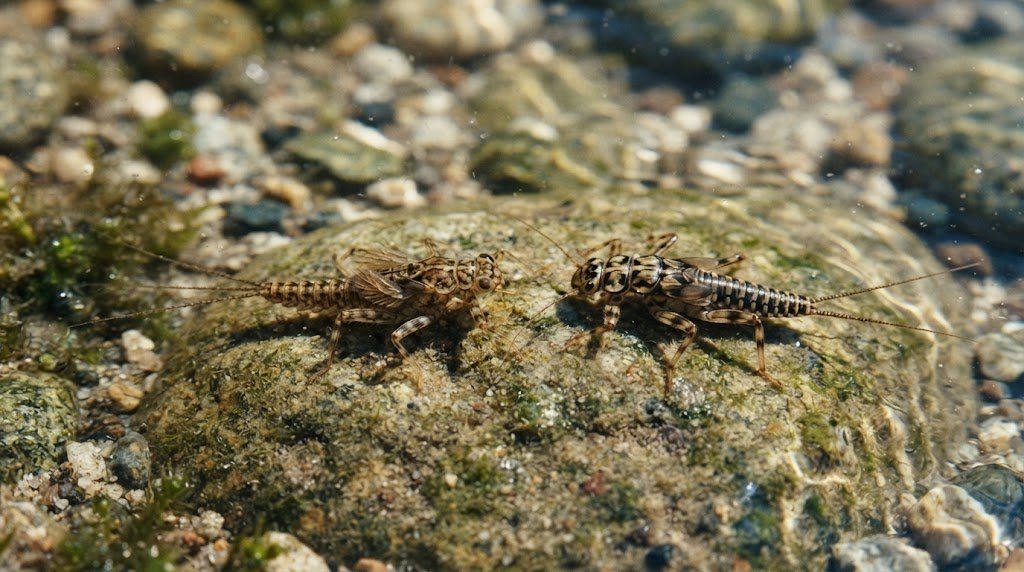
In headwater streams, newly fallen terrestrial leaves cannot be immediately digested by aquatic insects. Terrestrial foliage is heavily fortified with structural cellulose, lignin, and defensive polyphenolic tannins that inhibit digestive proteases. Before a shredder stonefly (such as Pteronarcys) or caddisfly (such as Pycnopsyche) can consume a leaf, the detritus must undergo microbial conditioning: aquatic hyphomycete fungi and aerobic bacteria colonize the leaf surface, breaking down pectin and tannins while enriching the detrital matrix with fungal mycelial proteins and lipids. Shredders selectively graze upon this lipid-rich fungal biofilm, inadvertently macerating the leaf skeleton into millions of fine FPOM particles that drift downstream.
Scrapers and the Periphyton Biofilm Dynamics of Mid-Order Streams
In 4th-to-6th-order streams with cobble substrates and abundant sunlight, the dominant primary producers form a complex mucilaginous matrix called periphyton (epilithon), comprising cyanobacteria, green algae, and stalked diatoms cemented by extracellular polymeric substances (EPS). Scrapers (Grazers)—such as snail gastropods, limpets, and flat-headed mayfly nymphs (Heptageniidae) equipped with hardened chitinous scraping mandibles—graze continuously across rock surfaces like microscopic lawnmowers, preventing algal senescence and maintaining high nutrient turnover rates.
The Serial Discontinuity Concept: How Dams Sever the Fluvial Gradient
While the River Continuum Concept provides an elegant theoretical model for pristine, free-flowing lotic networks, modern continental rivers are heavily regulated by anthropogenic infrastructure. In 1984, Dr. Jack Stanford and Dr. James Ward formulated the Serial Discontinuity Concept (SDC) to explain how impoundments (dams and reservoirs) disrupt the continuous longitudinal physical-biological gradient.
When a massive hydroelectric or flood-control dam is constructed on a 5th-order river, it creates an abrupt limnological reset. The reservoir behind the dam acts as an artificial lake—trapping bedload sediment, clarifying the water column, altering water temperatures, and settling out suspended FPOM. Downstream of a deep-release hypolimnetic dam, tailwaters receive cold, oxygen-depleted, sediment-starved water (‘hungry water’) that scours downstream gravel beds into armored cobble pavements, extirpating native scrapers and replacing diverse macroinvertebrate assemblages with monocultures of cold-tolerant blackfly larvae (Simuliidae) and amphipods.
Applying the RCC to Modern Watershed Assessment and Bio-Criteria
For water quality managers, understanding the RCC is crucial for establishing baseline biological criteria. An aquatic bioassessment that expects high numbers of scraper mayflies in a shaded 2nd-order headwater stream—or expects high shredder stonefly richness in a deep 8th-order river—will misdiagnose a healthy, natural lotic ecosystem as degraded! Bioindicator benchmarks must always be calibrated to the specific Strahler stream order, catchment geology, and expected longitudinal position along the fluvial continuum.
Nutrient Spiraling Mechanics: Uptake Length (Sw) and Carbon Turnover
In closed lentic ecosystems, nutrients cycle in localized vertical loops between the epilimnion and bottom sediments. In lotic (flowing) systems, however, unidirectional downstream displacement stretches circular nutrient cycles into an open, moving helix—a fundamental process termed Nutrient Spiraling (Webster and Patten, 1979; Newbold et al., 1981).
A single nutrient spiral comprises two distinct physical distances: the distance an atom of dissolved nutrient travels in the water column before being biologically assimilated by a benthic biofilm (Uptake Length, $S_w$), and the subsequent distance that assimilated atom travels bound inside organic biomass (or drifting downstream as an organism or detrital particle) before being remineralized back into the dissolved inorganic pool (Turnover Length, $S_b$). The total Spiraling Length ($S$) is the sum of both parameters:
S = Sw + Sb = [u * h / vf] + Sb
Where $u$ is mean stream velocity, $h$ is water depth, and $v_f$ is the biological nutrient uptake velocity (a direct metric of benthic microbial affinity for phosphorus or ammonium). In pristine, shallow 2nd-order headwaters with dense cobble periphyton and abundant woody debris, uptake length ($S_w$) is very short (often $< 15$ to 30 meters)—meaning the stream re-uses and retains nutrients dozens of times before releasing them downstream. In contrast, in canalized, deep, sediment-smothered rivers, $S_w$ extends to kilometers, turning the stream into an open nutrient pipe that exports agricultural pollution directly to coastal seas.
The Flood Pulse Concept: Lateral Hydrological Connectivity in Lowland Rivers
While the River Continuum Concept focuses primarily on longitudinal upstream-to-downstream transport, Dr. Wolfgang J. Junk and colleagues formulated the Flood Pulse Concept (FPC) in 1989 to explain high-order lowland tropical and temperate rivers. In massive river basins (such as the Amazon, Congo, or lower Mississippi), the dominant ecological driver is not longitudinal drift from headwaters, but lateral hydrological expansion across the Aquatic Terrestrial Transition Zone (ATTZ). Annual flood pulses inundate thousands of square kilometers of floodplain forests and backwaters, dissolving terrestrial organic matter, stimulating massive fish spawning migrations into drowned vegetation, and depositing fertile alluvial silts that sustain continent-scale ecological productivity.
Catchment Deforestation and Thermal Canopy Rupture
When industrial logging, agriculture, or urban suburbanization clears the contiguous riparian forest canopy along 1st- and 2nd-order headwater streams, the fundamental energy dynamics predicted by the River Continuum Concept are violently inverted. Stripped of shade, summer solar irradiance striking the shallow water surface surges by over 800%, driving maximum daily water temperatures upward by 6°C to 11°C. Cold-stenothermic organisms—specifically stoneflies (Plecoptera) and native brook trout (Salvelinus fontinalis)—suffer acute physiological respiratory collapse as dissolved oxygen saturation plunges while metabolic oxygen demand doubles under thermal Arrhenius kinetics.
Simultaneously, the loss of autumn allochthonous leaf fall deprives the benthic shredder guild of its primary caloric food base. Relieved of light limitation, the rocky stream bed is rapidly blanketed by dense blooms of filamentous green algae (such as Cladophora) and diatoms. The headwater stream is prematurely forced into an artificial autotrophic state ($P/R > 1.0$), fundamentally decoupling the evolutionary energetic linkages that downstream collector and filterer communities rely upon across the entire river network.
Field Hydrometry Protocols and Annual Catchment Survey Schedule
Field implementation of The River Continuum Concept in a working river basin requires disciplined adherence to standardized hydrometry protocols. Stream channels exhibit profound temporal variability: baseflow conditions in late summer expose low-flow hydraulic geometries, while spring snowmelt and autumn convective storms mobilize bedload sediment and reshape gravel bars.
A professional lotic monitoring program coordinates cross-sectional surveying, velocity gauging, bed material pebble counts, and continuous water quality logging across four distinct hydrological stages. Use the operational field matrix below to align river surveys with annual hydrograph dynamics.
| Hydrological Stage | Flow Regime & Stage Height | Channel Energy & Hydraulic Focus | Mandatory Field Survey Protocol | Critical Safety & QA/QC Precautions |
|---|---|---|---|---|
| Early Spring Freshet | High Stage / Snowmelt Peak | Near Bankfull (High bed shear tau_0) | Deploy bridge-mounted ADCP or cableway winch for peak discharge Q | Never wade swift water; tether boat rigs; verify velocity sensor calibration |
| Post-Flood Late Spring | Receding Bankfull to Med Flow | Sediment sorting & bar deposition | Survey cross-sectional geometry at monumented pins; assess bank erosion BEHI | Inspect benchmark datum elevations; check monument stability against scour |
| Summer Baseflow (Dry Period) | Low Stage / Groundwater Fed | Subcritical tranquil flow (Fr < 0.3) | Perform 100-particle Wolman pebble counts; sample benthic macroinvertebrates | Wade along riffle transects; inspect periphyton cover; calibrate optical DO |
| Autumn Storm Pulses | Flash Stage Rises (Rain events) | Transient storage & organic drift | Measure suspended sediment concentration (SSC) & turbidity sonde spikes | Clean optical wiper blades on multi-parameter sondes; check solar battery voltage |
Wolman Pebble Count Standardization for Streambed Particle Sizing
Bed material size distribution ($D_{50}$, $D_{84}$) governs roughness, sediment mobility, and spawning gravel quality. To execute an unbiased Wolman Pebble Count (Wolman, 1954) across a representative riffle reach:
- Blind Sampling Geometry: Step along a zig-zag transect across the active bankfull channel. At each step, avert your eyes, reach down with your index finger at the tip of your boot, and retrieve the first particle your finger touches.
- Measuring the Intermediate Axis (b-axis): Measure the particle’s intermediate dimension ($b$-axis—neither the longest length nor the thinnest thickness) using a gravelometer template or precision caliper to the nearest millimeter.
- Cumulative Frequency Distribution (100 Particles Minimum): Tally particles into standard Wentworth size classes (<2mm silt/sand, 2–4mm, 4–8mm, up to >256mm boulders). Plot grain size on a log scale against cumulative percent finer to extract $D_{16}$, $D_{50}$ (median diameter), and $D_{84}$ for shear stress modeling.
Frequently Asked Questions Concerning Fluvial Dynamics & River Science
Why is bankfull discharge considered the most effective geomorphic flow?
While rare 100-year catastrophic floods move enormous boulders, they occur so infrequently that their cumulative geological work is limited. Conversely, everyday baseflows occur constantly but lack the shear stress required to move gravel. Bankfull discharge (occurring roughly every 1.5 years) balances moderate frequency with high sediment-transport capacity, performing the highest percentage of total annual bedload movement and sculpting permanent channel dimensions.
How does large woody debris (LWD) benefit stream hydraulics?
Large fallen trees and root wads increase channel boundary roughness, dissipating excess flood energy and preventing downstream bed incision. Furthermore, water flowing around log jams scours out deep, cold plunge pools that provide critical summer thermal refugia for trout and salmon while creating stable depositional gravel beds for spawning.
What is the difference between suspended load and bedload?
Suspended load consists of fine clays and silts held aloft in the water column by turbulent fluid eddies, traveling at nearly the same velocity as the flowing water. Bedload consists of coarse sands, gravels, and cobbles that roll, slide, and bounce (saltate) along the streambed, moving intermittently only when critical bed shear stress exceeds the Shields threshold.