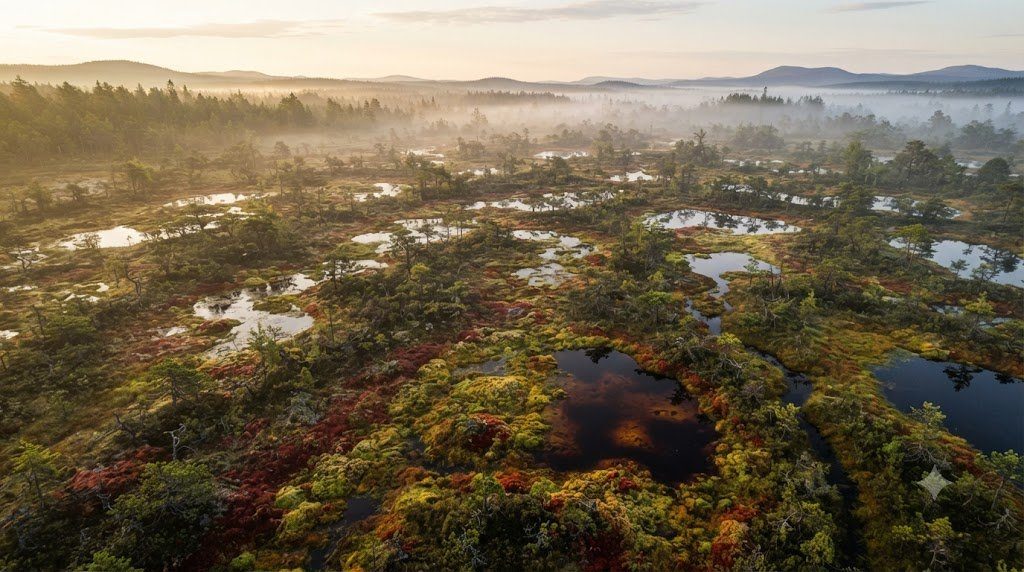
Covering merely 3% of the Earth’s terrestrial land surface, peatlands (mires) represent the undisputed heavyweight champion of global terrestrial carbon sequestration. Remarkably, these waterlogged, sponge-like ecosystems store over 550 to 600 gigatons of carbon—more than twice the carbon stored in the entire combined biomass of all the world’s forests! From the vast boreal peat basins of the Western Siberian Lowlands and Canada’s Hudson Bay Lowlands to temperate kettle-hole bogs and tropical peat swamp forests, peatlands serve as irreplaceable climate stabilizers and continental freshwater sponges.
At the heart of the vast majority of northern peatlands stands an extraordinary keystone organism: peat moss (genus Sphagnum). Sphagnum is not merely a passive moss growing in wet dirt; it is an active ecosystem engineer that deliberately terraforms its physical and chemical environment—acidifying water, engineering extreme water-holding capacity, and halting biological decay. In this monograph, we analyze the limnological distinction between Ombrotrophic Bogs and Minerotrophic Fens, Sphagnum cation-exchange chemistry, and peatland carbon stability under climate change.
Bogs vs. Fens: The Hydrochemical and Hydrological Divide
All peatlands accumulate partially decayed organic matter (peat), but limnologists classify them into two fundamentally distinct hydrological and chemical categories based on their water source:
| Peatland Classification | Primary Hydrological Water Source | Water Chemistry & pH Range | Electrical Conductivity (EC) | Dominant Vegetative Community |
|---|---|---|---|---|
| Ombrotrophic Bog (Rain-Fed) | 100% Atmospheric Precipitation & Fog only (Zero groundwater contact) | Severely Acidic (pH 3.0 to 4.5); nutrient-poor (Oligotrophic) | < 30 to 50 μS/cm (Extremely low dissolved ions) | Sphagnum moss carpet, carnivorous sundews (Drosera), pitcher plants (Sarracenia), Ericaceae shrubs |
| Poor Fen (Intermediate) | Mixed precipitation + very weak groundwater flow | Moderately Acidic (pH 4.5 to 5.5); low nutrients | 50 to 100 μS/cm | Mix of Sphagnum species, Carex sedges, cotton-grass (Eriophorum) |
| Rich Fen (Groundwater-Fed) | Mineral-rich regional groundwater discharge (Telmatotrophic) | Circumneutral to Alkaline (pH 6.5 to 8.2); Calcium/Magnesium rich | > 150 to 400+ μS/cm (Hard, mineralized water) | True mosses (Brown mosses / Bryopsida), calciphile orchids, diverse Cyperaceae sedges |
| Patterned Peatland (Aapa Mire) | Slope groundwater seepage creating string/flark microtopography | Variable pH (Bogs on strings, fens in flarks) | Moderate | Alternating ridges of black spruce/sphagnum with open water flarks |
How Sphagnum Moss Acidifies Its Environment (Cation Exchange)
Why are ombrotrophic Sphagnum bogs as acidic as vinegar (pH 3.2 to 4.0)? The cell walls of Sphagnum contain enormous concentrations of polyuronic acids (pectin-like structural polymers with unesterified carboxyl groups, $-COOH$). As dilute rainwater containing dissolved mineral cations (such as calcium $Ca^{2+}$, magnesium $Mg^{2+}$, and potassium $K^+$) trickles over the moss, Sphagnum acts like an industrial water-softening ion-exchange column: it absorbs the divalent mineral cations and pumps out stoichiometric quantities of free hydrogen ions ($H^+$ / Hydronium $H_3O^+$) into the pore water!
By deliberately driving pore-water pH below 4.0, Sphagnum accomplishes two evolutionary goals: first, it chemically poisons competing vascular plants and trees that cannot tolerate extreme acidity; second, low pH completely inhibits bacterial and fungal decay enzymes (such as polyphenol oxidases and cellulases), preventing its dead lower stems from decaying and building towering mounds of peat that rise meters above the regional water table (Raised Bogs).
The Acrotelm and Catotelm: Two-Layer Peatland Hydrodynamics
A peat profile is divided horizontally into two structurally and biologically distinct layers established by Ingram (1978):
- The Acrotelm (Upper Active Layer): The top 10 to 50 cm of the peat bog. It consists of living, actively growing Sphagnum heads, fresh dead plant litter, high hydraulic conductivity ($K > 10^{-3} \text{ m/s}$), fluctuating water tables, and periodic aerobic microbial decay. As new moss grows upward, older stems are compressed under their own weight.
- The Catotelm (Deep Anoxic Reservoir): Extends from the minimum summer water table down to the mineral bedrock (often 2 to 10+ meters deep). The catotelm is permanently water-saturated, 100% anoxic, has extremely low hydraulic conductivity ($K < 10^{-7} \text{ m/s}$), and hosts near-zero biological decay. Carbon entering the catotelm is effectively sequestered from the global carbon cycle for thousands of years.
Peatland Degradation, Drainage Fires, and Positive Climate Feedback
When peatlands are ditched and drained for forestry, peat extraction, or agriculture, the water table drops, exposing the catotelm to atmospheric oxygen. Aerobic bacteria awaken, decomposing millennia of stored organic carbon and releasing billions of tons of carbon dioxide ($CO_2$) and nitrous oxide into the atmosphere. Worse, dried peat becomes fuel for catastrophic, smoldering subterranean zombie fires that burn underground for months through sub-zero winters, releasing toxic haze and creating an accelerating positive feedback loop that intensifies global climate warming.
The Peat Decomposition Index: Von Post Humification Scale
In wetland soil science and peatland engineering, the physical degree of organic matter breakdown down a vertical core is quantified using the international von Post Humification Scale (H1 through H10), performed via a rapid tactile field squeeze test:
| von Post Scale Class | Peat Humification Level | Physical Description & Plant Structure | Pore Water Expressed Upon Squeezing | Extrusion of Peat Between Fingers |
|---|---|---|---|---|
| H1 to H2 | Completely Undecomposed | Pristine living/dead plant stems clearly visible; fibrous | Crystal clear to pale yellow water expressed | Zero peat passes between fingers; remains fibrous |
| H3 to H4 | Weakly / Moderately Decomposed | Plant structure easily recognizable; distinct moss leaves | Turbid yellow to brown water; low sediment | Zero peat extrudes; residue is moderately fibrous |
| H5 to H6 | Moderately to Strongly Decomposed | Plant structure indistinct; fibers broken into pulp | Very dark brown muddy water expressed | Up to one-third of peat extrudes through fingers as paste |
| H7 to H8 | Strongly Decomposed | Very few plant structures recognizable; dense organic paste | Very little free water; thick dark slurry | Over half of peat mass extrudes between fingers |
| H9 to H10 | Completely Humified (Muck) | Zero recognizable plant structures; amorphous organic gel | Zero free water expressed | 100% of peat paste escapes between fingers like butter |
Methanotrophic Biofiltration in Sphagnum Canopies
Although deep anoxic peat bogs generate massive quantities of dissolved methane ($CH_4$) via methanogenic archaea in the catotelm, wild Sphagnum bogs emit far less methane to the atmosphere than predicted. Why? Because the living upper 10 cm of the Sphagnum canopy hosts symbiotic methanotrophic bacteria living inside dead hyaline cells. As methane gas bubbles up from the deep anoxic peat, these aerobic methanotrophs oxidize up to 80% of the methane into carbon dioxide and biomass before it escapes into the air, acting as a crucial planetary greenhouse-gas filter.
Sphagnan Chemistry and Bog Body Preservation Mechanics
Why do prehistoric human bodies, leather shoes, and wooden artifacts buried in Sphagnum bogs for over 2,500 years (such as Tollund Man and Grauballe Man in Denmark) survive in near-perfect states of anatomical preservation? The answer lies in a complex bioactive pectin-like polysaccharide unique to Sphagnum cell walls: Sphagnan (Painter, 1991).
As Sphagnum moss dies and forms peat, sphagnan hydrolyzes, releasing reactive keto-uronic acid residues into the pore water. Sphagnan executes three powerful biochemical preservation mechanisms: first, it aggressively chelates and strips essential divalent metal ions (such as calcium $Ca^{2+}$ and iron $Fe^{2+}$) required by bacterial collagenase and protease enzymes; second, it reacts directly with bacterial cell-wall enzymes, rendering them permanently inactive; third, it acts like commercial tanning liquor, cross-linking animal dermal collagen and tanning human skin into dark, durable, decay-resistant leather that survives for millennia.
Peatland Restoration: Ditch Blocking and Sphagnum Re-Seeding
To rehabilitate degraded peatlands drained for historical agriculture, wetland conservationists deploy Peat Rewetting and Ditch Blocking. Heavy machinery installs interlocking plastic piling dams, peat bunds, or timber check dams across artificial drainage ditches every 10 to 20 meters, raising the subterranean water table back to within 5 cm of the ground surface. Restored wetlands are then re-seeded with living Sphagnum fragments using mechanical straw-mulch spreading (the Moss Layer Transfer Technique). Within 3 to 5 years, a continuous living moss carpet re-establishes, extinguishing subterranean fire hazards and restoring the bog’s active carbon-sequestration engine.
Wetland Hydroperiod Monitoring and Soil Inundation Tracking
Applying the science of Peatland Limnology and Sphagnum Ecology in environmental permitting or ecological restoration requires rigorous long-term hydrological logging. Because wetland water tables fluctuate dramatically between spring precipitation peaks and late-summer evapotranspiration troughs, establishing jurisdictional wetland hydrology demands continuous groundwater monitoring.
Under regulatory guidelines (such as the US Army Corps of Engineers Wetland Delineation Manual), an area satisfies the hydrological parameter if it is saturated to the surface for at least 14 consecutive days during the regional growing season. Review the wetland hydrologic monitoring matrix below across various wetland classes.
| Wetland Hydrogeomorphic Class | Dominant Water Source | Typical Hydroperiod Duration | Water Level Monitoring Technique | Key Diagnostic Hydrologic Field Indicators |
|---|---|---|---|---|
| Depressional / Vernal Pool | Precipitation & surface runoff; perched | Seasonal ephemeral (3 to 5 months in spring) | Staff gauge + vented pressure transducer logger | Water marks on tree trunks; fairy shrimp presence; moss trim lines |
| Riverine / Riparian Floodplain | Overbank river flooding & hyporheic | Seasonal pulses (Spring freshets & storm events) | Shallow slotted PVC monitoring wells across terrace | Sediment deposits on leaves; drift lines; scour marks on trees |
| Fringe / Lacustrine Wetland | Lake seiches and seasonal lake levels | Permanent to semi-permanent shallow inundation | Continuous lake-edge pressure transducer logger | Aquatic fauna in shallow water; water-stained leaves; oxidized rhizospheres |
| Organic Soil Bog / Fen | Precipitation (Bog) or Groundwater discharge (Fen) | Permanently saturated (Water table within 0–30 cm) | Perforated piezometers driven into catotelm peat | Saturated hydric soils within 12 inches; hydrogen sulfide odor; stunted trees |
| Slope / Groundwater Seep | Subsurface unconfined aquifer discharge | Perennial to seasonal continuous seepage | Drive-point mini-piezometers measuring upward head | Iron deposits in seeping water; active redox depletions; hydrophytic herbs |
Vegetation Sampling: The 50/20 Rule for Dominant Hydrophytes
To verify the Hydrophytic Vegetation parameter during a formal wetland delineation, field botanists sample plant strata (trees, saplings, shrubs, herbs, woody vines) along standardized circular plots, applying the 50/20 Rule:
- Calculate Total Cover: Rank all plant species in a vegetative stratum in descending order of absolute percent cover.
- Identify the 50% Threshold: Sum the cover percentages from highest to lowest. All species that contribute to reaching 50% of the total cumulative cover are designated as Dominant Species.
- Include the 20% Additions: Any individual species that accounts for at least 20% of the total cover for that stratum is also included as a Dominant Species.
- The Dominance Test: If more than 50% of the dominant species across all strata have a Wetland Indicator Status of OBL (Obligate Wetland), FACW (Facultative Wetland), or FAC (Facultative), the plant community passes the regulatory hydrophytic vegetation criteria!
Frequently Asked Questions Concerning Wetland Ecology & Biogeochemistry
Why do wetland soils smell like rotten eggs when disturbed?
The rotten-egg odor is hydrogen sulfide gas ($H_2S$). In permanently waterlogged hydric soils, extreme anaerobic conditions exhaust all oxygen, nitrate, manganese, and iron electron acceptors (Redox Stage 5: -100 to -200 mV). Sulfate-reducing bacteria reduce dissolved sulfate ($SO_4^{2-}$) into toxic hydrogen sulfide, signaling deep, chronic anoxia.
What is the difference between an obligate and facultative wetland plant?
Obligate Wetland plants (OBL, such as cattails and water lilies) occur in wetlands >99% of the time under natural conditions. Facultative Wetland plants (FACW, such as green ash and sensitive fern) occur in wetlands 67% to 99% of the time. Facultative plants (FAC) occur with equal probability (33%–67%) in wetlands and uplands.
Can a constructed wetland treat raw municipal sewage without pretreatment?
No! Constructed treatment wetlands are designed for secondary and tertiary wastewater polishing. Feeding raw, untreated sewage directly into a wetland will rapidly blind gravel pore spaces with large solids, smother macrophyte roots, and cause catastrophic hydraulic clogging. Wastewater must always pass through a septic tank or primary settling clarifier first to remove settleable solids and grease.