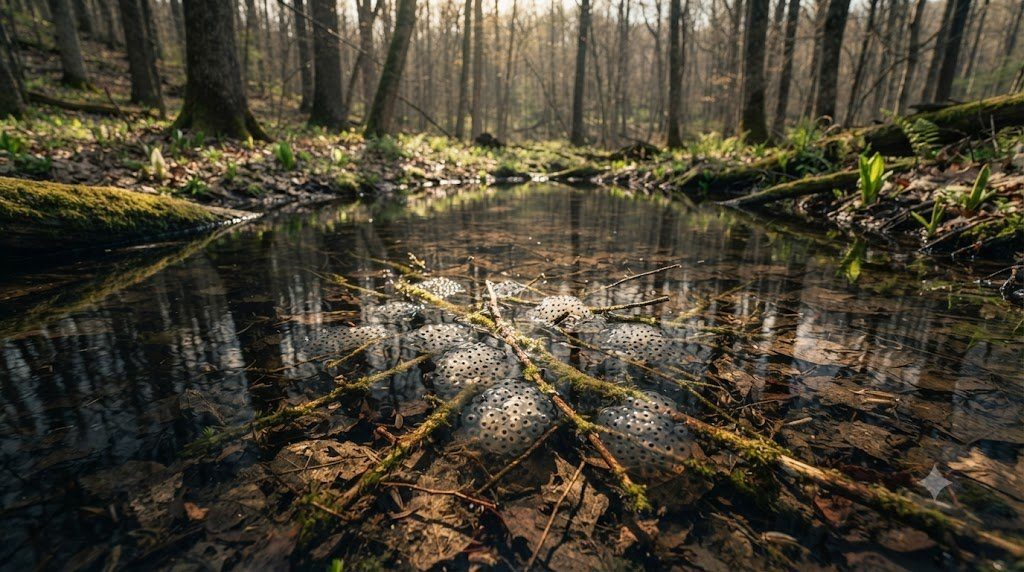
Hidden within temperate deciduous forests, Mediterranean grasslands, and pine flatwoods lie some of the most ecologically vital and hydrologically fragile freshwater habitats on the planet: Vernal Pools (Ephemeral Seasonal Wetlands). Filled by winter snowmelt, early-spring rains, and rising seasonal groundwater tables, vernal pools reach peak volume in April and May, only to completely desiccate into bone-dry, cracked forest floor depressions by mid-summer.
To the untrained eye, a dry forest depression in August appears devoid of life. In reality, the cyclical drying of a vernal pool is its greatest biological asset: periodic desiccation completely eliminates predatory fish populations! Deprived of fish predators, vernal pools serve as exclusive, irreplaceable reproductive nurseries for specialized obligate fauna that cannot survive in permanent lakes or streams. In this monograph, we examine hydroperiod kinematics, soil perched water tables, the life history of fairy shrimp (Anostraca), and the chemical cues of mole salamander breeding migrations.
Hydroperiod Dynamics and Perched Groundwater Hydrology
The ecological viability of a vernal pool is governed entirely by its Hydroperiod—the duration, frequency, and seasonal timing of standing surface water inundation. Hydrologically, vernal pools typically occupy isolated topographic depressions underlain by an impermeable restrictive layer:
- Perched Aquifers & Restrictive Hardpans: Beneath the organic leaf litter of the pool floor lies a dense, impermeable clay layer (fragipan), cemented iron hardpan, or unweathered bedrock. Precipitation and snowmelt pool on top of this restrictive horizon, forming a localized perched water table completely disconnected from the deeper regional groundwater aquifer.
- The 3-to-5 Month Biological Inundation Window: For a vernal pool to support obligate pool-breeding amphibians, it must maintain standing water for a minimum of 12 to 16 weeks (approx. 3 to 4 months). If a pool dries too early (in 6 to 8 weeks due to spring drought), amphibian tadpoles and fairy shrimp perish before metamorphosis. Conversely, if a pool remains wet year-round, predatory green frogs, bullfrogs, and sunfish colonize, devouring vulnerable vernal pool specialists.
| Vernal Pool Obligate Organism | Taxonomic Group | Desiccation Survival Mechanism | Metamorphic Timeline Requirement | Ecological Indicator Status |
|---|---|---|---|---|
| Fairy Shrimp (Eubranchipus vernalis) | Crustacea: Anostraca | Cryptobiotic resting cysts buried in dry mud for years | Rapid development: 2 to 4 weeks under cool water | Primary Obligate Vernal Pool Bioindicator |
| Spotted Salamander (Ambystoma maculatum) | Amphibia: Ambystomatidae | Adults live in terrestrial burrows; migrate to pool in spring | Aquatic egg & larval phase: 70 to 100 days to metamorphosis | Obligate Forest-Pool Vernal Specialist |
| Wood Frog (Lithobates sylvaticus) | Amphibia: Ranidae | Adults freeze solid in winter forest litter (glycerol cryoprotectant) | Fastest larval metamorphosis: 45 to 60 days | Explosive early-spring pool breeder |
| Marbled Salamander (Ambystoma opacum) | Amphibia: Ambystomatidae | Females lay eggs in dry pool bed in Autumn; hatch on winter flood | Winter/spring aquatic larvae: 120–150 days | Autumn-breeding obligate specialist |
| Clam Shrimp & Tadpole Shrimp | Branchiopoda (Spinicaudata/Notostraca) | Desiccation-resistant encysted resting embryos | Ephemeral spring hatch (3 to 6 weeks) | Secondary Obligate Pool Bioindicator |
Amphibian Explosive Breeding and Terrestrial-Aquatic Energy Flux
On the first warm, rainy night of early spring—the legendary ‘Big Night’ (temperatures $> 5^\circ\text{C}$ / $40^\circ\text{F}$ with steady rain)—hundreds of adult mole salamanders (Ambystoma spp.) and wood frogs emerge from subterranean rodent burrows across the forest floor and march simultaneously toward their natal vernal pool. Within 48 hours, the pool erupts in frenzied courtship: male salamanders deposit spermatophores on leaves, females lay gelatinous symbiotic egg masses (colonized by the green alga Oophila amblystomatis, which provides oxygen directly to developing embryos), and wood frogs form massive communal egg rafts.
Over the subsequent 100 days, developing larvae graze on periphyton and zooplankton, transforming aquatic primary production into animal biomass. When hundreds of thousands of juvenile metamorphs emerge from the drying pool in July, they disperse into the surrounding upland forest, exporting massive pulses of high-quality protein and lipids into terrestrial food webs, nourishing birds, small mammals, and woodland reptiles.
Regulatory Vulnerability and Landscape-Scale Conservation
Because vernal pools are small (often $< 0.1$ hectare) and completely isolated from navigable rivers by dry upland terrain, they frequently fall through regulatory loopholes in wetland protection legislation (such as changing Supreme Court definitions of 'Waters of the United States' and significant nexus tests). Protecting vernal pools requires more than saving the seasonal puddle itself: mole salamanders spend 95% of their adult lives in terrestrial forest habitat within a 250-meter radius (the Critical Terrestrial Buffer) of the breeding pool. Conserving vernal pool biodiversity necessitates protecting both the ephemeral aquatic basin and the surrounding mature upland forest canopy.
Water Budget Kinematics: Balancing Infiltration, ET, and Precipitation
The seasonal filling and drying curve of a vernal pool is governed by a micro-catchment water mass-balance equation:
ΔS = (P + RO + GWin) – (ET + I + GWout)
Where $\Delta S$ is the change in pool water storage volume, $P$ is direct precipitation, $RO$ is surface runoff from surrounding forested micro-catchment slopes, $GW_{in}$ is perched groundwater seepage, $ET$ is evapotranspiration, $I$ is deep percolation infiltration through the bed hardpan, and $GW_{out}$ is lateral subsurface discharge. In early spring, low tree transpiration and frozen subsoil drive $\Delta S$ positive, rapidly filling the pool. In June, the fully leafed deciduous forest canopy transpires thousands of gallons of water per acre per day, creating a massive vapor pressure deficit that drives $\Delta S$ negative, evaporating the pool to dry mud.
Conservation Genetics: Vernal Pool Metapopulations and Dispersal Corridors
Mole salamanders and wood frogs exhibit extreme site fidelity (philopatry), with over 90% of surviving adults returning to breed in the exact pool where they hatched. However, a landscape of vernal pools functions as an integrated metapopulation: occasional dispersing juveniles (5% to 10%) migrate 500 to 1,000 meters to colonize neighboring pools, providing essential genetic gene flow and preventing inbreeding depression. Fragmenting the forest with roads or housing subdivisions severs dispersal corridors, causing local populations to blink out permanently when a single pool suffers a multi-year drought.
Predatory Invertebrate Successional Cascades in Ephemeral Waters
Although vernal pools lack predatory fish, they are far from peaceful paradises. As a pool fills in March and warms through May, it undergoes an intense predatory macroinvertebrate ecological succession:
- Early Season (March to Early April): The pool is dominated by herbivorous and detritivorous pioneers: swimming fairy shrimp (Eubranchipus), copepods, and newly hatched wood frog tadpoles. Water is cold ($< 8^\circ\text{C}$), and large predators are absent.
- Mid-Season (Late April to May): Voracious invertebrate predators emerge: giant predaceous diving beetles (Dytiscidae, such as Dytiscus verticalis), water scorpions (Nepidae), and backswimmers (Notonectidae). Dytiscid beetle larvae (‘water tigers’) possess hollow sickle-shaped mandibles that inject digestive proteases into salamander larvae and fairy shrimp, liquefying their tissues in minutes.
- Late Season (June): Aerial colonizers dominate: massive green darner dragonfly nymphs (Aeshnidae), phantom midge larvae (Chaoborus), and predatory caddisflies. The race to achieve metamorphosis before the pool dries reaches a frantic climax.
Artificial Vernal Pool Construction: Synthetic Liners vs. Compaction
In mitigation banking, environmental engineers construct artificial vernal pools to replace destroyed seasonal wetlands. Early attempts using synthetic EPDM rubber pond liners frequently failed because puncture tears drained the pool too early, or smooth liners prevented burrowing salamanders from climbing out. Modern construction utilizes heavy clay subsoil compaction: heavy bulldozers compact native clay subsoils to an engineered permeability of $K < 10^{-8} \text{ m/s}$, topped with 20 cm of loose forest topsoil and decaying oak leaf litter inoculated with fairy shrimp cysts harvested from regional donor pools, achieving a natural 4-month hydroperiod.
Landscape-Level Metapopulation Dynamics and Terrestrial Buffer Ecology
Conserving vernal pool ecosystems requires managing more than the isolated pool basin alone; it demands landscape-scale protection of the surrounding upland terrestrial forest. Pool-breeding amphibians, such as spotted salamanders (Ambystoma maculatum) and wood frogs (Lithobates sylvaticus), spend less than four weeks of their adult annual life cycle inside the aquatic pool basin. For the remaining eleven months, juvenile and adult amphibians inhabit deep upland subterranean rodent burrows, decayed root cavities, and decomposing coarse woody debris within an essential 250-to-300-meter critical terrestrial buffer surrounding the wetland. Clearcutting or paving this terrestrial perimeter severs biological dispersal corridors, causing regional pool metapopulations to collapse despite the aquatic basin remaining physically intact.
Wetland Hydroperiod Monitoring and Soil Inundation Tracking
Applying the science of Vernal Pools and Ephemeral Wetland Hydrology in environmental permitting or ecological restoration requires rigorous long-term hydrological logging. Because wetland water tables fluctuate dramatically between spring precipitation peaks and late-summer evapotranspiration troughs, establishing jurisdictional wetland hydrology demands continuous groundwater monitoring.
Under regulatory guidelines (such as the US Army Corps of Engineers Wetland Delineation Manual), an area satisfies the hydrological parameter if it is saturated to the surface for at least 14 consecutive days during the regional growing season. Review the wetland hydrologic monitoring matrix below across various wetland classes.
| Wetland Hydrogeomorphic Class | Dominant Water Source | Typical Hydroperiod Duration | Water Level Monitoring Technique | Key Diagnostic Hydrologic Field Indicators |
|---|---|---|---|---|
| Depressional / Vernal Pool | Precipitation & surface runoff; perched | Seasonal ephemeral (3 to 5 months in spring) | Staff gauge + vented pressure transducer logger | Water marks on tree trunks; fairy shrimp presence; moss trim lines |
| Riverine / Riparian Floodplain | Overbank river flooding & hyporheic | Seasonal pulses (Spring freshets & storm events) | Shallow slotted PVC monitoring wells across terrace | Sediment deposits on leaves; drift lines; scour marks on trees |
| Fringe / Lacustrine Wetland | Lake seiches and seasonal lake levels | Permanent to semi-permanent shallow inundation | Continuous lake-edge pressure transducer logger | Aquatic fauna in shallow water; water-stained leaves; oxidized rhizospheres |
| Organic Soil Bog / Fen | Precipitation (Bog) or Groundwater discharge (Fen) | Permanently saturated (Water table within 0–30 cm) | Perforated piezometers driven into catotelm peat | Saturated hydric soils within 12 inches; hydrogen sulfide odor; stunted trees |
| Slope / Groundwater Seep | Subsurface unconfined aquifer discharge | Perennial to seasonal continuous seepage | Drive-point mini-piezometers measuring upward head | Iron deposits in seeping water; active redox depletions; hydrophytic herbs |
Vegetation Sampling: The 50/20 Rule for Dominant Hydrophytes
To verify the Hydrophytic Vegetation parameter during a formal wetland delineation, field botanists sample plant strata (trees, saplings, shrubs, herbs, woody vines) along standardized circular plots, applying the 50/20 Rule:
- Calculate Total Cover: Rank all plant species in a vegetative stratum in descending order of absolute percent cover.
- Identify the 50% Threshold: Sum the cover percentages from highest to lowest. All species that contribute to reaching 50% of the total cumulative cover are designated as Dominant Species.
- Include the 20% Additions: Any individual species that accounts for at least 20% of the total cover for that stratum is also included as a Dominant Species.
- The Dominance Test: If more than 50% of the dominant species across all strata have a Wetland Indicator Status of OBL (Obligate Wetland), FACW (Facultative Wetland), or FAC (Facultative), the plant community passes the regulatory hydrophytic vegetation criteria!
Frequently Asked Questions Concerning Wetland Ecology & Biogeochemistry
Why do wetland soils smell like rotten eggs when disturbed?
The rotten-egg odor is hydrogen sulfide gas ($H_2S$). In permanently waterlogged hydric soils, extreme anaerobic conditions exhaust all oxygen, nitrate, manganese, and iron electron acceptors (Redox Stage 5: -100 to -200 mV). Sulfate-reducing bacteria reduce dissolved sulfate ($SO_4^{2-}$) into toxic hydrogen sulfide, signaling deep, chronic anoxia.
What is the difference between an obligate and facultative wetland plant?
Obligate Wetland plants (OBL, such as cattails and water lilies) occur in wetlands >99% of the time under natural conditions. Facultative Wetland plants (FACW, such as green ash and sensitive fern) occur in wetlands 67% to 99% of the time. Facultative plants (FAC) occur with equal probability (33%–67%) in wetlands and uplands.
Can a constructed wetland treat raw municipal sewage without pretreatment?
No! Constructed treatment wetlands are designed for secondary and tertiary wastewater polishing. Feeding raw, untreated sewage directly into a wetland will rapidly blind gravel pore spaces with large solids, smother macrophyte roots, and cause catastrophic hydraulic clogging. Wastewater must always pass through a septic tank or primary settling clarifier first to remove settleable solids and grease.