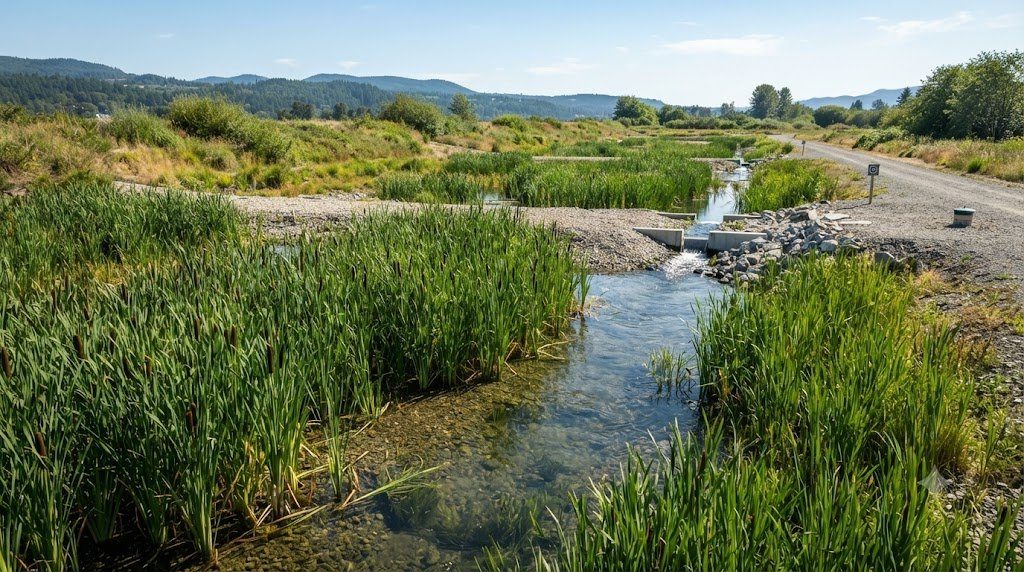
As municipal wastewater treatment plants and industrial facilities face escalating chemical costs, energy demands, and strict nutrient discharge limits, civil engineers and aquatic limnologists have increasingly turned to nature’s most sophisticated biofilter: Constructed Treatment Wetlands (CTWs). Rather than relying on energy-intensive mechanical blowers and synthetic chemical coagulants, engineered wetlands harness the synergistic interactions of hydraulic retention time, saturated gravel substrates, microbial biofilm succession, and emergent macrophyte root zones to treat domestic sewage, agricultural runoff, landfill leachate, and acid mine drainage.
Engineered wetlands operate with zero chemical inputs and near-zero electricity, delivering 90% to 99% reductions in Biochemical Oxygen Demand ($BOD_5$), total suspended solids (TSS), enteric pathogens, and heavy metals. In this technical engineering manual, we deconstruct the design physics of Free Water Surface (FWS) vs. Subsurface Flow (SSF) wetlands, hydraulic sizing protocols, macrophyte phytoremediation pathways, and cold-climate operating strategies.
Engineering Classifications: FWS vs. Horizontal & Vertical SSF Systems
Constructed treatment wetlands are categorized into three primary hydraulic configurations based on water flow vector and exposure to the atmosphere:
| Wetland Engineering Design | Hydraulic Flow Regime | Substrate Media | Oxygen Transfer Capacity | Best Water Treatment Application |
|---|---|---|---|---|
| Free Water Surface (FWS) | Open shallow water (0.2–0.6m) flowing over soil bed | Native hydric soil / silty clay liner | Low (Atmospheric diffusion + algal O2) | Municipal effluent polishing, stormwater retention, wildlife habitat |
| Horizontal Subsurface Flow (HSSF) | Water flows horizontally below gravel surface | Washed crushed gravel (10–20 mm size) | Very Low (Strictly anaerobic / anoxic) | Secondary domestic wastewater; excellent denitrification and BOD removal |
| Vertical Flow Subsurface (VF-SSF) | Intermittent dosing flooded onto sand/gravel bed | Graded sand (0–2 mm) over coarse gravel | Very High (Convective air sucked into pores) | Total nitrification of ammonium (NH4+ -> NO3-); high organic shock tolerance |
| Hybrid Multi-Stage Wetland | Vertical Flow stage followed by Horizontal Flow stage | Graded sand beds feeding gravel beds | Optimal (Aerobic nitrification then anaerobic denitrification) | Complete total nitrogen (TN) removal for high-strength agricultural effluent |
The Kadlec & Wallace First-Order Kinetic Sizing Model
Engineered wetlands are sized using first-order plug-flow kinetic models pioneered by Dr. Robert Kadlec and Scott Wallace (the $k-C^*$ model):
ln[(Cout – C*) / (Cin – C*)] = -k / q
Where $C_{in}$ is influent contaminant concentration, $C_{out}$ is target effluent limit, $C^*$ is the background natural wetland concentration, $k$ is the areal rate constant (m/year), and $q$ is the hydraulic loading rate ($q = Q / A$, flow divided by wetland surface area). This formula allows environmental engineers to calculate the exact square meters of wetland area required to achieve statutory water quality compliance.
Emergent Macrophytes: Biological Engines of the Rhizosphere
While microbes perform over 80% of biochemical pollutant breakdown in a wetland, emergent wetland plants (macrophytes) provide the essential physical and biological infrastructure:
- Typha latifolia (Broadleaf Cattail): Fast-growing emergent plant producing massive underground rhizome networks. Cattails tolerate extreme chemical shock loads, absorb heavy metals into root tissues, and provide dense shade that prevents nuisance surface algae.
- Phragmites australis (Common Reed): Deep-rooting species whose roots penetrate over 1.0 meter into gravel beds. Their continuous root expansion prevents hydraulic gravel clogging and channels atmospheric oxygen into the deep matrix.
- Scirpus acutus / Schoenoplectus tabernaemontani (Softstem Bulrush): Highly efficient at root radial oxygen loss (ROL), creating localized aerobic oxidation pockets that break down industrial hydrocarbons and surfactants.
- Iris pseudacorus & Juncus effusus (Soft Rush): Prized for aesthetic landscapes and secondary nutrient polishing, secreting natural antimicrobial exudates that kill coliform bacteria.
Winter Cold-Climate Engineering Strategies
A frequent skepticism of treatment wetlands is: How do they operate during sub-zero northern winters? Because microbial reaction rates follow the Arrhenius temperature equation ($k_T = k_{20} \cdot \theta^{(T-20)}$), bacterial decomposition slows down in cold water. In northern latitudes (such as Minnesota, Canada, and Scandinavia), engineers overcome winter chill through two brilliant physical adaptations: first, raising the water level 10 cm in November, allowing an insulating top ice layer to form, and then dropping the water level 5 cm—creating an insulating dead-air thermal blanket beneath the ice; second, placing a 30 cm layer of dry woodchips, composted mulch, or straw over the gravel bed, which keeps subsurface water temperatures at 4°C to 8°C throughout the winter freeze.
Hydraulic Retention Time (HRT) and Dye Tracer Dispersion Modeling
The pollutant removal efficiency of any constructed treatment wetland is fundamentally constrained by its Hydraulic Retention Time (HRT, $ au$)—the actual time wastewater spends contacting the biofiltration media:
τ = (V * ε) / Q = (L * W * d * ε) / Q
Where $V$ is total wetland basin volume ($m^3$), $\epsilon$ is media porosity (typically 0.35 to 0.40 for 20 mm clean gravel), $L$ and $W$ are bed length and width, $d$ is saturated water depth, and $Q$ is daily volumetric inflow rate ($m^3/day$). If a wetland suffers from hydraulic short-circuiting (where water rushes down the center channel while corner zones remain stagnant), the true mean retention time collapses, resulting in untreated effluent discharge. Environmental engineers verify plug-flow hydraulics by injecting conservative rhodamine WT tracers and calculating the Hydraulic Efficiency Coefficient ($\lambda = t_p / au$).
Heavy Metal Phytoremediation: Rhizofiltration and Biosequestration
In constructed wetlands treating industrial effluents or acid mine drainage (AMD), plants execute rhizofiltration. Macrophytes such as Typha and Phragmites absorb dissolved heavy metal cations (copper $Cu^{2+}$, zinc $Zn^{2+}$, lead $Pb^{2+}$, and cadmium $Cd^{2+}$) across root cell membranes via zinc-regulated transporter proteins (ZIP family), sequestering toxic ions inside root cell vacuoles bound to phytochelatins and metallothionein proteins, permanently isolating heavy metals from aquatic food webs.
Clogging Forensics in Subsurface Flow Wetlands (Biofilm vs. Silting)
The primary long-term operational failure mode of Horizontal Subsurface Flow (HSSF) gravel wetlands is hydraulic media clogging (matrix blinding). Over 10 to 15 years of continuous wastewater loading, the void spaces between gravel stones ($10\text{–}20 \text{ mm}$) can become choked, forcing water to pond on the surface and short-circuit untreated. Clogging material comprises three distinct physical components:
- Refractory Mineral Silts (25% to 35%): Fine inorganic sediments washed in from stormwater runoff or poorly settled municipal primary effluent.
- Living and Dead Microbial Biomass (30% to 45%): Thick mucilaginous biofilms composed of extracellular polymeric substances (EPS, polysaccharides, and proteins) secreted by dense colonies of heterotrophic bacteria.
- Dead Plant Root and Rhizome Litter (20% to 30%): Fibrous dead plant roots that fail to decompose under strict subsurface anaerobic conditions.
Preventative Engineering: Slotted Inflow Manifolds and Rest Cycles
To prevent matrix clogging, environmental engineers install adjustable slotted PVC inflow manifolds that distribute wastewater uniformly across the entire width of the bed, paired with an inlet gravel pack made of oversized 50-to-80 mm cobbles. Furthermore, multi-cell wetland systems are operated in alternating cycles: Cell A receives wastewater for 7 days while Cell B is drained and rested. Resting allows atmospheric oxygen to penetrate the gravel voids, stimulating aerobic bacteria to rapidly oxidize and digest accumulated organic biofilms, restoring full hydraulic conductivity without excavating the gravel.
Heavy Metal Phytostabilization and Rhizofiltration Dynamics
Beyond biological nitrogen and phosphorus removal, constructed wetlands serve as resilient biogeochemical sinks for industrial heavy metals such as zinc ($Zn$), copper ($Cu$), cadmium ($Cd$), and lead ($Pb$). In subsurface gravel media, heavy metals are immobilized through a synergy of abiotic precipitation as insoluble metal sulfides ($MeS$) under sulfate-reducing redox conditions, surface adsorption onto iron-manganese oxyhydroxides, and active rhizofiltration by macrophyte root zones. Emergent wetland species—such as Phragmites australis and Typha latifolia—sequester toxic ions within subterranean root cortical tissues via metallothionein and phytochelatin peptide complexation, permanently preventing hazardous metal translocation into above-ground biomass or downstream municipal drinking aquifers.
Wetland Hydroperiod Monitoring and Soil Inundation Tracking
Applying the science of Constructed Treatment Wetlands in environmental permitting or ecological restoration requires rigorous long-term hydrological logging. Because wetland water tables fluctuate dramatically between spring precipitation peaks and late-summer evapotranspiration troughs, establishing jurisdictional wetland hydrology demands continuous groundwater monitoring.
Under regulatory guidelines (such as the US Army Corps of Engineers Wetland Delineation Manual), an area satisfies the hydrological parameter if it is saturated to the surface for at least 14 consecutive days during the regional growing season. Review the wetland hydrologic monitoring matrix below across various wetland classes.
| Wetland Hydrogeomorphic Class | Dominant Water Source | Typical Hydroperiod Duration | Water Level Monitoring Technique | Key Diagnostic Hydrologic Field Indicators |
|---|---|---|---|---|
| Depressional / Vernal Pool | Precipitation & surface runoff; perched | Seasonal ephemeral (3 to 5 months in spring) | Staff gauge + vented pressure transducer logger | Water marks on tree trunks; fairy shrimp presence; moss trim lines |
| Riverine / Riparian Floodplain | Overbank river flooding & hyporheic | Seasonal pulses (Spring freshets & storm events) | Shallow slotted PVC monitoring wells across terrace | Sediment deposits on leaves; drift lines; scour marks on trees |
| Fringe / Lacustrine Wetland | Lake seiches and seasonal lake levels | Permanent to semi-permanent shallow inundation | Continuous lake-edge pressure transducer logger | Aquatic fauna in shallow water; water-stained leaves; oxidized rhizospheres |
| Organic Soil Bog / Fen | Precipitation (Bog) or Groundwater discharge (Fen) | Permanently saturated (Water table within 0–30 cm) | Perforated piezometers driven into catotelm peat | Saturated hydric soils within 12 inches; hydrogen sulfide odor; stunted trees |
| Slope / Groundwater Seep | Subsurface unconfined aquifer discharge | Perennial to seasonal continuous seepage | Drive-point mini-piezometers measuring upward head | Iron deposits in seeping water; active redox depletions; hydrophytic herbs |
Vegetation Sampling: The 50/20 Rule for Dominant Hydrophytes
To verify the Hydrophytic Vegetation parameter during a formal wetland delineation, field botanists sample plant strata (trees, saplings, shrubs, herbs, woody vines) along standardized circular plots, applying the 50/20 Rule:
- Calculate Total Cover: Rank all plant species in a vegetative stratum in descending order of absolute percent cover.
- Identify the 50% Threshold: Sum the cover percentages from highest to lowest. All species that contribute to reaching 50% of the total cumulative cover are designated as Dominant Species.
- Include the 20% Additions: Any individual species that accounts for at least 20% of the total cover for that stratum is also included as a Dominant Species.
- The Dominance Test: If more than 50% of the dominant species across all strata have a Wetland Indicator Status of OBL (Obligate Wetland), FACW (Facultative Wetland), or FAC (Facultative), the plant community passes the regulatory hydrophytic vegetation criteria!
Frequently Asked Questions Concerning Wetland Ecology & Biogeochemistry
Why do wetland soils smell like rotten eggs when disturbed?
The rotten-egg odor is hydrogen sulfide gas ($H_2S$). In permanently waterlogged hydric soils, extreme anaerobic conditions exhaust all oxygen, nitrate, manganese, and iron electron acceptors (Redox Stage 5: -100 to -200 mV). Sulfate-reducing bacteria reduce dissolved sulfate ($SO_4^{2-}$) into toxic hydrogen sulfide, signaling deep, chronic anoxia.
What is the difference between an obligate and facultative wetland plant?
Obligate Wetland plants (OBL, such as cattails and water lilies) occur in wetlands >99% of the time under natural conditions. Facultative Wetland plants (FACW, such as green ash and sensitive fern) occur in wetlands 67% to 99% of the time. Facultative plants (FAC) occur with equal probability (33%–67%) in wetlands and uplands.
Can a constructed wetland treat raw municipal sewage without pretreatment?
No! Constructed treatment wetlands are designed for secondary and tertiary wastewater polishing. Feeding raw, untreated sewage directly into a wetland will rapidly blind gravel pore spaces with large solids, smother macrophyte roots, and cause catastrophic hydraulic clogging. Wastewater must always pass through a septic tank or primary settling clarifier first to remove settleable solids and grease.